By FcForged Editorial Team
How are offset and backspacing different?
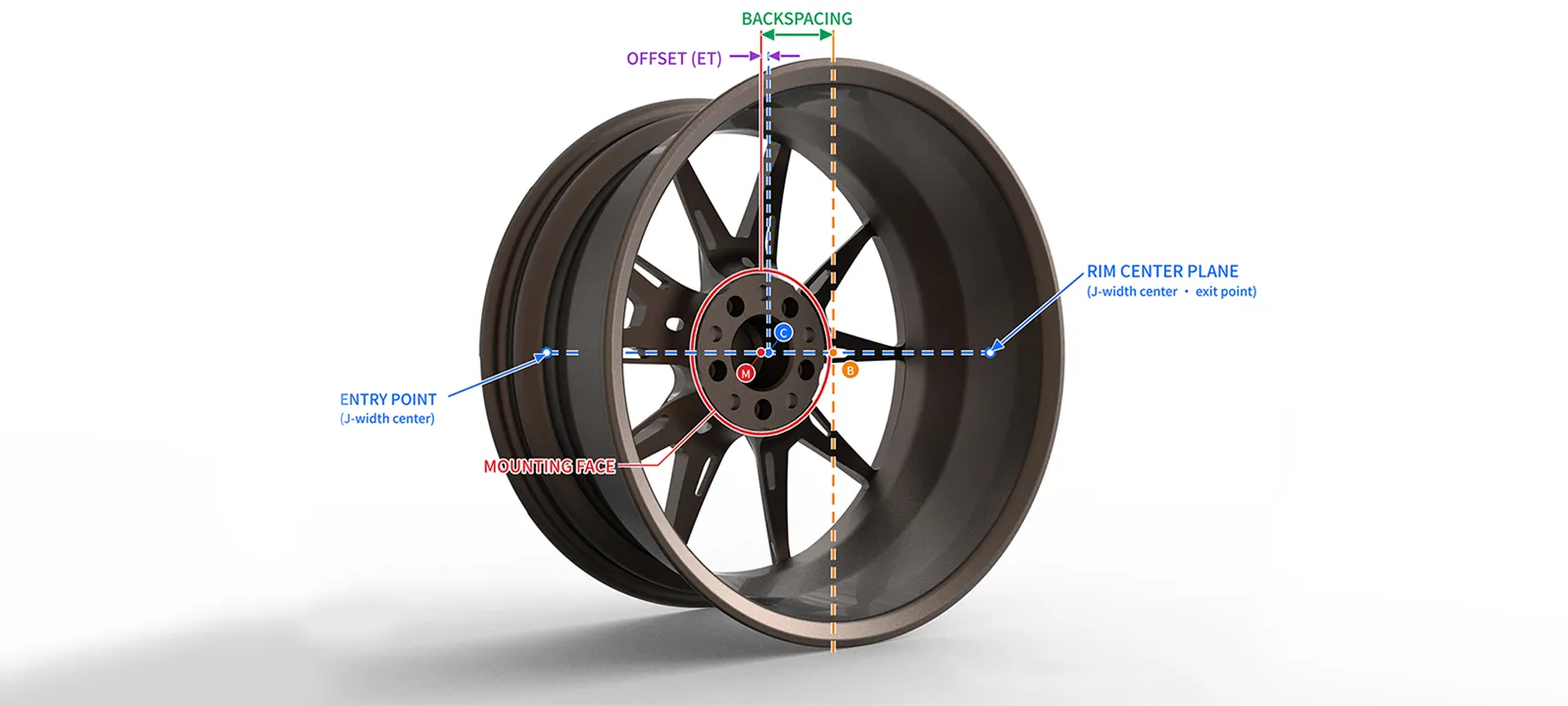
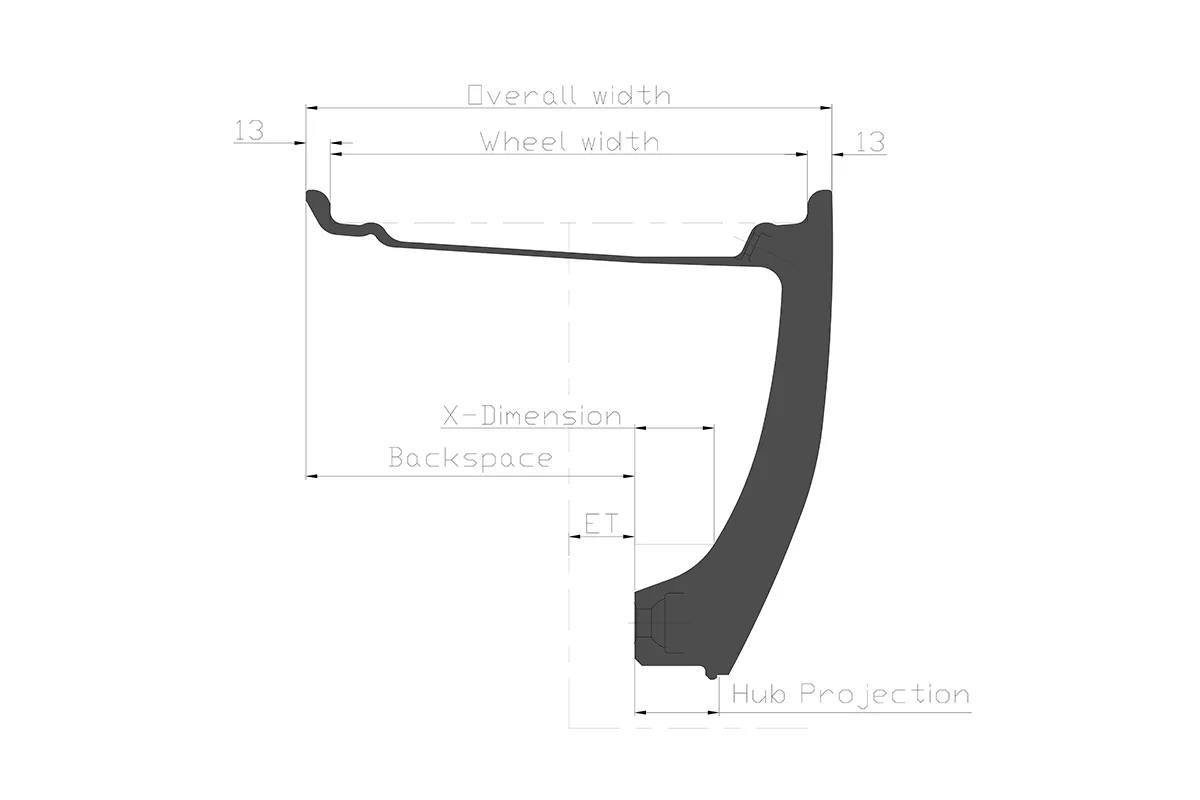
Wheel offset locates the mounting face relative to the wheel’s centerline; backspacing measures from that mounting face to the wheel’s inner edge.
They describe different reference distances, so an ET number and a backspacing measurement cannot be substituted for each other. Velgen’s explanation of offset and backspacing distinguishes the centerline reference from the rear-edge reference.
| Specification | Reference points | How to record it |
|---|---|---|
| Offset, often written as ET | Wheel centerline to mounting face | Signed value in millimeters |
| Backspacing | Mounting face to inner wheel edge | Measured distance with its unit |
Positive offset places the mounting face toward the wheel’s outside face relative to its centerline. Negative offset places it toward the inside; zero offset places it on the centerline. Keep the sign when copying an ET value into a quote request.
For a buyer, the useful first question is which measurement the supplier is asking for. Send the source drawing or measurement record with the value so both sides can identify the same reference points.
Why does wheel width matter when you compare them?
Compare wheel width alongside offset because the same ET value does not describe the same inner and outer envelope on wheels of different widths.
This follows from the different reference points: offset uses the centerline, while backspacing reaches an edge. An unchanged centerline-to-mounting-face distance does not establish where that edge ends after the wheel becomes wider.
Record the complete size of both the existing and proposed wheel. Avoid a request such as “keep my offset” without identifying the width that accompanies it. If a drawing gives a backspacing dimension, retain the drawing’s unit and measurement definition rather than replacing it with a value inferred from a product title.
Treat online calculations as comparisons to discuss with the supplier. Ask which width and edge references a calculation uses before putting its result on an approved drawing. The calculation alone does not confirm brake, suspension, tire or body clearance.
What does a real front-and-rear specification show?
The documented RX-7/TW023 build shows why the offset sign and axle position must stay attached to each wheel size.
FcForged’s 1986 Mazda RX-7 FC3S Pandem example uses the following configuration, recorded with its TW023 step-lip mesh wheels:
| Axle | Wheel diameter and width | Offset |
|---|---|---|
| Front | 18 × 9.5 in | ET-35 |
| Rear | 18 × 10.5 in | ET-63 |
The wheels share a diameter, but both width and offset differ. A request for “18-inch wheels with negative offset” would lose the information that distinguishes the two axles. Dropping the minus sign would change the recorded offset itself.
These dimensions describe that customer build only. They do not establish a fitment for another RX-7 or another vehicle. The cited specification gives offset, not a measured backspacing value; this guide does not convert it into an asserted backspacing dimension.
For the broader distinction between matching and different front/rear sizes, see what staggered wheels mean.
Which measurements should you send for a quote?
Send the existing and requested specifications separately, with front and rear clearly identified.
Use this as a collection checklist rather than a set of suggested dimensions:
- Vehicle year, make, model and trim, plus brake or suspension changes.
- Existing wheel diameter, width and signed offset, with the source of each value.
- Proposed wheel diameter, width and offset, if already specified.
- Backspacing, if requested, including its unit and how it was measured.
- Tire size, bolt pattern and center bore in their own fields.
- Drawings or installer observations that explain a clearance concern.
If the only record is a mark on an existing wheel, send a clear photo of that mark and identify which axle it came from. If it is a requested change, label it as proposed. This helps prevent a preference from being copied into the file as a measured fact.
Use the wheel quote checklist to organize the remaining order details, including quantity, finish and destination.
What should happen before you approve the wheel?
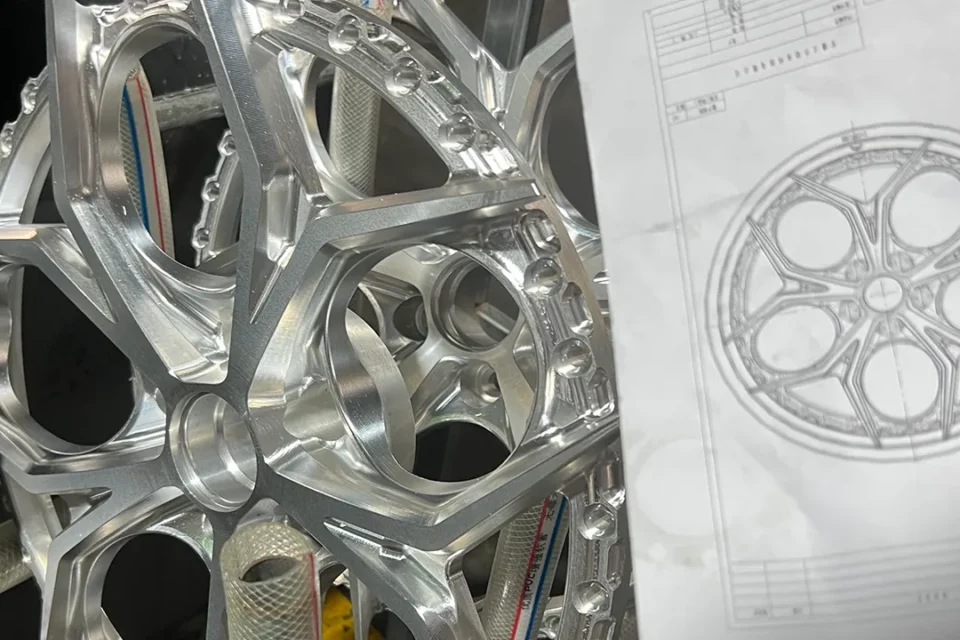
Approve a complete drawing that identifies the intended wheel and its mounting dimensions, then arrange the applicable fitment checks for that configuration.
Compare the drawing with your request: diameter and width, signed ET, bolt pattern, center bore and any backspacing dimension specifically required for the project. Check that front and rear entries have not been swapped and that an existing-wheel measurement has not been mistaken for a requested change.
Ask the supplier or installer to explain any discrepancy before approval. Keep the final drawing version with the quote, including which information has been confirmed for the intended vehicle and which further physical checks are required. Neither an offset number nor a backspacing number is a complete fitment decision.
Send your current wheel record and proposed changes with the inquiry. Request a wheel quote with your fitment details